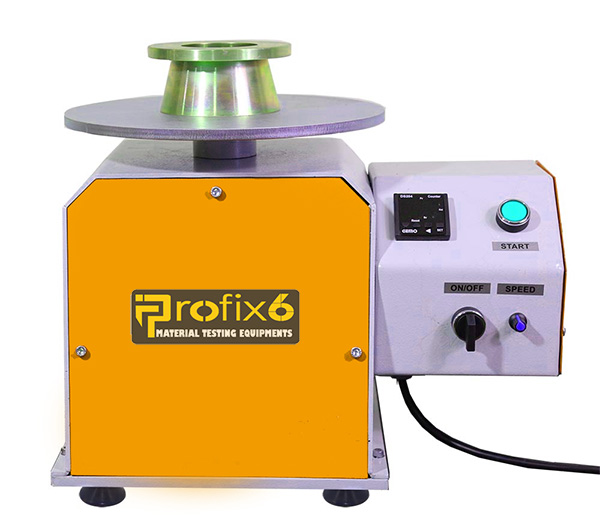
The Motorized Cement flow tables are used for determining the consistency of mortar, lime and cement specimens.
The Motor operated models cement flow tables are driven by a motor speed reducer coupling at the rate of one rev per second. The number of drop can preset on a counter and the machine stops automatically at the end of the cycle.
Cement Flow Tables consists of the following equipment;
• Brass Flow Mould,
• Filling Hopper and Tamper.
Purpose of Cement Flow Table Test:
Cement Spreading Table is used for spreading (fluidity) tests of mortar, lime, cement samples. It is aimed to determine the fresh consistency and spread value of the mortar containing mineral binder and dense aggregate or light aggregate immediately after mixing.
The wet sample, which is placed on the spreading table of standard shape and size, with the help of a mold of standard shape and size, is subjected to vibration by turning the handle of the device. The arm lifts the spreading table upwards and lowers it by releasing it from a certain height. The spreading value of the fresh mortar sample is determined by measuring the mean diameter of the spread mortar sample.
Equipments to be Used in the Cement Flow Table Experiment:
• Brass or Stainless Steel Flow Mould,
• Filling Hopper and Tamper.
How to Performing the Cement Flow Table Experiment in EN 1015-3 Standard?
• The truncated cone shaped mold made of stainless steel or brass, 60 mm high, with a base inner diameter of 100 mm and an upper inner diameter of 70 mm, is lubricated with a fluid mineral oil.
• The funnel is placed centered on the surface of the flow table.
• It is checked whether it works by turning the lifting handle.
• For the mortar to be tested, the cement mortar prepared with 450g cement is placed in the mold in two layers. At least 10 short strokes are made with the hammer until each layer of mortar is evenly distributed over the mortar surface.
• The remaining mortar is scraped off with a leveling knife or spatula. • The parts that overflow on the table are cleaned by wiping.
• After waiting for 15 seconds, the die ring is removed in a vertical direction.
• The table is lowered 15 times, once per second.
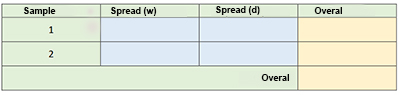
• The spreading mortar mass diameter is measured in mm in two perpendicular directions and averaged.
• The test is carried out for two samples.
• If more than 10% deviation is observed between the spreading values of the two experiments, the experiments are repeated.
• The remaining cement mortar from this test can be used in the next test, consistency analysis (vikat).
Result:
The flow of the cement is acoount by substituting the obtained reading values in the table below.
![]()